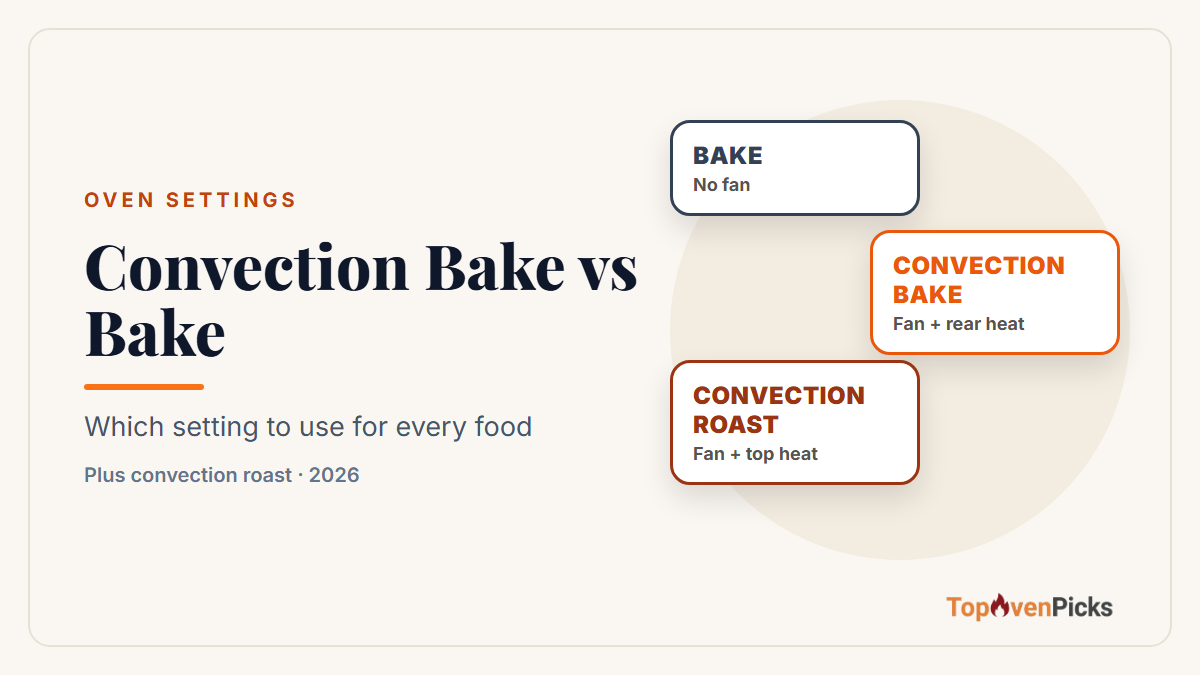
The difference in convection bake vs bake is the fan. Bake heats your oven mainly from the bottom with still air, which is gentle and ideal for cakes and breads. Convection bake uses a fan (often with a third heating element) to circulate hot air, so food cooks about 25% faster and browns more evenly, which is ideal for cookies, pies and multiple racks. Convection roast adds more top heat for deep browning on meats and vegetables.
Quick Answer: Which Setting Should You Use?
- Use Bake for cakes, quick breads, muffins, cheesecakes, custards, soufflés and anything that needs to rise gently or stay moist.
- Use Convection Bake for cookies, pies, pastries, casseroles, sheet-pan dinners and baking on more than one rack.
- Use Convection Roast for whole chicken, turkey, beef and pork roasts and crispy roasted potatoes and vegetables.
- What each oven setting does
- Bake vs convection bake vs convection roast
- Which setting for each food
- How to adjust temperature and time
- Convection bake vs convection roast
- True convection vs regular convection
- When not to use convection
- Pans, racks and foil
- Best rack positions
- Common mistakes
- Gas vs electric ovens
- FAQs
What Each Oven Setting Does
Every setting on your oven is simply a different combination of heating elements and the fan. The diagrams show which parts switch on (orange) in a typical electric oven. Exact behavior varies by brand, so check your manual.
Bake
Heat rises from the bottom element (or gas burner). No fan, gentle and moist.
Cakes, breads, custardsConvection Bake
A fan (often with a rear element) circulates hot air for even, faster baking.
Cookies, pies, multi-rackConvection Roast
Fan plus more heat from the top element for deeper browning.
Chicken, roasts, potatoesBroil
Intense direct heat from the top element only.
Melting, charring, finishingAir Fry
Top heat with a fast fan for extra-crisp results on a single rack.
Fries, wings, nuggetsWarm / Proof
Very low heat to hold cooked food or help dough rise.
Holding food, bread doughBake vs Convection Bake vs Convection Roast
| Bake | Convection Bake | Convection Roast | |
|---|---|---|---|
| Main heat source | Bottom element or burner | Fan + rear element (or bottom element) | Fan + top and bottom elements |
| Fan | Off | On | On |
| Airflow | Still air, natural hot spots | Even, circulating | Circulating, stronger top heat |
| Cooking speed | Standard | About 25% faster | About 25% faster or more |
| Browning | Mostly from below | Even all around | Deep, especially on top |
| Moisture | Retains more | Dries surfaces faster | Dries and crisps skin |
| Temp adjustment | Use recipe temp | Lower about 25°F (unless auto-converted) | Often recipe temp; check food early |
| Multiple racks | Not ideal | Excellent | One rack usually |
| Best for | Cakes, breads, custards | Cookies, pies, pastry, casseroles | Meats, poultry, roast vegetables |
Want to know how the fan changes cooking in general? Read convection vs conventional ovens.
Which Setting for Each Food?
| Food | Best setting | Why |
|---|---|---|
| Layer cakes and sponge cakes | Bake | Fan can make tops set early and dome or crack |
| Quick breads and muffins | Bake | Gentle heat for a full rise |
| Cheesecake, custards, flan | Bake | Even, moist heat prevents cracks |
| Soufflés | Bake | Airflow can make them lean or fall |
| Yeast bread loaves | Either | Bake for rise; convection for crisper crust |
| Cookies | Convection bake | Even browning, multiple trays at once |
| Pies and tarts | Convection bake | Crisp, golden crust |
| Puff pastry and croissants | Convection bake | Fast heat helps layers puff |
| Casseroles (uncovered) | Convection bake | Browned, bubbly top |
| Frozen pizza and fries | Convection bake | Crispier results |
| Whole chicken and turkey | Convection roast | Crisp skin, juicy meat, faster |
| Beef and pork roasts | Convection roast | Better crust |
| Roasted potatoes and vegetables | Convection roast | Caramelized edges |
| Covered braises and stews | Bake | Lid traps moisture; fan adds little |
Roasting a turkey or prime rib? Use a leave-in meat thermometer, since convection cooks faster than recipe times expect.
How to Adjust Temperature and Time
Because circulating air transfers heat more efficiently, convection cooks faster. The standard rules:
Option 1: Lower the temperature
- Reduce the recipe temperature by about 25°F
- Keep the time about the same
- Start checking a few minutes early
Option 2: Shorten the time
- Keep the recipe temperature
- Cut the cooking time by about 25%
- Best for roasts and sturdy foods
Example: a recipe for 375°F for 20 minutes becomes about 350°F for 18–20 minutes on convection bake.
- Check for auto-conversion. Many modern ovens automatically lower the set temperature by 25°F when you choose convection bake. If yours does, don't lower it again. Look for "auto convert" or "recipe conversion" in your manual or settings. Not sure which button is convection? See our oven symbols guide.
- Convection roast is often not converted. Many ovens leave the temperature as set for convection roast. Keep the recipe temperature and rely on a thermometer.
- Big roasts save the most time. A large turkey can finish noticeably sooner on convection roast, so start checking well before the recipe time.
Quick conversion table
| Recipe says (Bake) | Convection Bake | Start checking |
|---|---|---|
| 325°F | 300°F | About 5 min early |
| 350°F | 325°F | About 5 min early |
| 375°F | 350°F | About 5 min early |
| 400°F | 375°F | 5–10 min early |
| 425°F | 400°F | 5–10 min early |
| 450°F | 425°F | 5–10 min early |
For a full conversion chart and food-by-food times, see how to use a convection oven.
Convection Bake vs Convection Roast
Both use the fan, but they balance the heat differently:
Convection Bake
- Even heat from all sides
- Designed for baked goods and multiple racks
- Often auto-lowers the temperature
- Gentler browning on top
Convection Roast
- Adds more heat from the top element
- Designed for meats and vegetables on one rack
- Usually keeps your set temperature
- Deeper browning and crisper skin
Using convection roast for cookies can over-brown the tops, and convection bake for a chicken works but gives slightly less color. Use a low-sided roasting pan with a rack for convection roast so air can reach the underside.
True Convection vs Regular Convection
Not all convection ovens work the same way:
- Regular (fan) convection uses a fan to circulate air heated by the oven's top and bottom elements. It's an improvement over bake, but heat can still be stronger near the elements.
- True (European or third-element) convection adds a heating element around the fan at the back, so the air is heated as it circulates. It gives the most even results, especially on multiple racks.
- Dual convection on some premium ovens uses two fans for even more consistent airflow in large cavities.
Check your oven's spec sheet or manual for "true convection," "third element" or "European convection." Shopping for a new range? Many of our best induction ranges include true convection.
When Not to Use Convection
- Delicate batters such as chiffon, angel food and sponge cakes can bake unevenly or set too fast.
- Custards and cheesecakes may crack or form a skin.
- Soufflés can lean or deflate in moving air.
- Light, loose foods such as parchment edges or delicate toppings can blow around.
- Covered dishes gain little because the lid blocks the airflow.
Pans, Racks and Foil
- Use low-sided pans. Rimmed baking sheets and shallow roasting pans let air reach the food. Tall sides block it. Our best cookie sheets guide covers good options.
- Leave space. Keep at least an inch between pans and the oven walls, and stagger pans on multiple racks.
- Light-colored metal gives the most even browning; dark pans brown faster on convection, so check early.
- Be careful with foil. Don't cover the rack or oven floor with foil, which blocks airflow and can damage the oven. Tent food loosely instead.
Best Rack Positions for Each Setting
- Bake: center rack for most single pans, so heat from below and above balances out. Use the lower-middle rack for pies that need a crisp bottom.
- Convection Bake: any rack works; for two or three sheets, space racks evenly and leave room between pans.
- Convection Roast: lower-middle or lowest rack for large roasts and turkeys, so the top isn't too close to the top element.
- Broil: top rack, 3–6 inches from the element, depending on how fast you want it to brown.
- Air Fry: the rack position your manual recommends, usually upper-middle, with food in a single layer.
Common Mistakes
- Lowering the temperature twiceIf your oven auto-converts, reducing it yourself as well will undercook food.
- Using convection for everythingDelicate cakes and custards are better on regular bake.
- Following recipe times exactlyConvection cooks faster, so check food 5–10 minutes early.
- Crowding the ovenPacking pans together blocks the air and cancels convection's advantage.
- Opening the door oftenEvery opening dumps hot air; use the oven light and window.
- Ignoring a weak fanIf convection results suddenly get worse, the fan or rear element may need service. See our oven troubleshooting guide.
Gas vs Electric Ovens
Settings work similarly in gas and electric ovens, but there are differences:
- Gas ovens bake with a burner under the oven floor and often broil with a burner at the top. Gas convection usually uses a fan to move the burner's heat, and fewer gas ovens have true third-element convection.
- Electric ovens are more likely to offer true convection, convection roast and air fry modes.
- Moisture: gas ovens produce some moisture as the gas burns, so they can feel slightly less drying on bake.
Not sure which you have? See gas vs electric ovens.
Convection Bake vs Bake FAQs
What is the difference between bake and convection bake?
Bake heats the oven mainly from the bottom with still air. Convection bake turns on a fan (and often a rear heating element) to circulate hot air, which cooks about 25% faster and browns more evenly.
Is convection bake better than bake?
For cookies, pies, pastry, casseroles and multi-rack baking, usually yes. For delicate cakes, custards, cheesecakes and soufflés, regular bake is better.
Do I need to lower the temperature for convection bake?
Usually by about 25°F, unless your oven converts automatically. Check your manual or the display: many ovens show the reduced temperature when you choose convection bake.
What is convection roast used for?
Meats, poultry and vegetables. It adds more heat from the top element for deeper browning and crisp skin, and usually works best on a single rack with a low-sided pan.
Can I bake a cake on convection?
You can, but many cakes rise more evenly on regular bake. If you use convection, lower the temperature by 25°F and check early. Sheet cakes and cupcakes handle convection better than tall layer cakes.
Is convection bake the same as air fry?
They're similar. Air fry uses a faster fan and stronger top heat for extra crisping on a single rack, while convection bake is gentler and designed for baking.
Does convection bake use more electricity?
The fan uses a little power, but because food cooks faster and often at a lower temperature, convection typically uses about the same or less energy overall.
Can you use convection bake for bread?
Yes, for a crisper, more evenly browned crust. Some bakers start on bake for maximum rise and switch to convection to finish. Breads baked in a covered Dutch oven gain little from the fan until the lid comes off.
Should I use convection for frozen foods?
Yes, convection bake is great for frozen pizza, fries and nuggets. Follow the package temperature, lower it about 25°F if your oven doesn't auto-convert, and check early.
Why is my convection oven not cooking faster?
Crowded pans, tall-sided dishes or a covered dish block the airflow. If results have changed suddenly, the convection fan or element may not be working.
The Bottom Line
Use Bake for anything delicate that needs to rise or stay moist, Convection Bake for cookies, pastry and multi-rack baking, and Convection Roast for meats and vegetables you want deeply browned. Lower the temperature about 25°F on convection bake unless your oven does it for you, and start checking food early.
About this guide
Researched and written by the TopOvenPicks editorial team. We compare manufacturer manuals and specifications to explain how oven features really work in home kitchens.
TopOvenPicks is reader-supported. When you buy through links on our site, we may earn an affiliate commission at no extra cost to you. Oven settings vary by brand, so always check your owner's manual.