The best leave-in meat thermometer stays in your roast the whole time it cooks, with a wired probe running to a display outside the oven, so you know the exact moment it's done without opening the door. We compared the top-rated wired models on Amazon, and these eight are worth buying.

TempPro TempTrack TP-16
The proven, simple leave-in thermometer for roasts and turkey.

ThermoWorks DOT
A pro-grade probe and dead-simple two-button alarm.
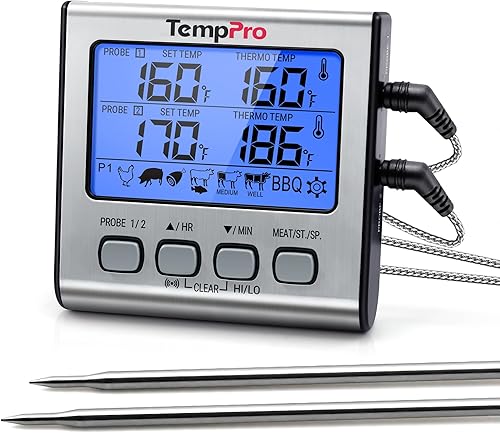
TempPro TempTrack TP-17
Watch two meats, or one meat plus the oven, at once.

TempPro TempTrack TP16S
The TP-16 idea with a backlight and faster updates.

Vuwwey Dual Probe 2-in-1
An instant-read thermometer and a wired leave-in probe in one.

Polder Classic
Classic split-screen thermometer with a separate timer.

CDN IRM200 Ovenproof
A simple dial that stays in the roast, no batteries or wires.

Escali AH1 Dial
An extra-large, easy-to-read dial for holiday roasts.
Quick Answer: The Best Leave-In Meat Thermometers
- Best overall: TempPro TempTrack TP-16. Simple, proven and rated 4.5 stars by 50,000+ owners.
- Best premium: ThermoWorks DOT. Pro-Series probe with a two-button alarm.
- Best dual probe: TempPro TempTrack TP-17. Track two meats, or the meat and your oven.
- Best 2-in-1: Vuwwey Dual Probe · No batteries: CDN IRM200 dial
Leave-In Meat Thermometers Compared
Prices change often, so tap Check to see today's price on Amazon.
| Thermometer | Type | Probes | Range | Alarm | Price |
|---|---|---|---|---|---|
| TempPro TP-16 Best Overall | Digital, wired | 1 | 32–572°F | Yes + timer | Check |
| ThermoWorks DOT Premium | Digital, wired | 1 | -58–572°F | Yes | Check |
| TempPro TP-17 Dual Probe | Digital, wired | 2 | 14–572°F | Yes + HI/LOW | Check |
| TempPro TP16S Backlit | Digital, wired | 1 | 14–572°F | Yes + timer | Check |
| Vuwwey Dual Probe 2-in-1 | Instant + wired | 2 | -58–572°F | Yes | Check |
| Polder Classic Thermometer + Timer | Digital, wired | 1 | 32–392°F | Yes + timer | Check |
| CDN IRM200 Analog | Ovenproof dial | Built-in | Meat temps | No | Check |
| Escali AH1 Large Dial | Ovenproof dial | Built-in | 140–190°F | No | Check |
How We Chose
We looked at wired leave-in thermometers and ovenproof dial thermometers sold on Amazon in the US, and kept models rated about 4.3 stars or higher by at least a thousand owners (DOT is the exception: it has fewer ratings but comes from ThermoWorks, the brand pro cooks trust most for accuracy). Wireless, app-based thermometers are covered in our separate guide to the best wireless meat thermometers. We then compared:
- Accuracy and range: stated accuracy, temperature range and the maximum heat the probe and cable can take.
- Ease of use: how quickly you can set a target, how readable the display is and how the base mounts.
- Useful features: alarms, presets, timers, backlights and second probes.
- Owner feedback: the most common praise and complaints, especially about accuracy drift and probe failures.
Specifications come from the manufacturers' listings. Our "What owners say" notes summarize Amazon's review highlights in our own words.
The Best Leave-In Meat Thermometers, Reviewed
TempPro TempTrack CORE TP-16 Digital Meat Thermometer
The simplest way to stop guessing: a wired probe stays in the roast while a big display outside the oven shows the temperature and beeps at your target.
Why we picked it
The TP-16 is the leave-in thermometer most home cooks start with, and with more than 50,000 ratings it's one of the most-reviewed kitchen thermometers on Amazon. You push the 6.5-inch stainless probe into the thickest part of the meat, close the oven door on the 40-inch mesh cable and watch the temperature on the base. When the food hits your target, it beeps.
It has USDA preset temperatures for common meats, which you can change to your own doneness, plus a countdown timer of up to 99 hours. The magnetic back sticks to the oven door or fridge, and there's also a stand and hanging hole. The step-down probe tip leaves a small hole and responds faster than a thick probe. It runs on one AAA battery.
Owners call it a fantastic kitchen tool that's easy to use and read, and like the magnet for sticking it to the oven. Accuracy gets mixed feedback: many say it's spot-on, while some report readings drifting. Several report the probe or unit failing after some months.
What we like
- Huge owner base and proven design
- Programmable alarm with USDA presets
- Long cable reaches across the counter
- Magnetic, stands or hangs
Watch out for
- Some owners report accuracy drift
- Probe can fail if the cable kinks or gets wet
ThermoWorks DOT Simple Alarm Thermometer
A chef-favorite alarm thermometer with a high-accuracy Pro-Series probe and almost nothing to learn: set the target, cook, listen for the beep.
Why we picked it
ThermoWorks is the name many pro cooks trust for accuracy, and DOT is its simplest leave-in thermometer. The listing notes it's the leave-in thermometer America's Test Kitchen recommends. There are no menus: press up or down to set your target temperature, and DOT alarms when the food gets there.
It uses ThermoWorks' Pro-Series probe, which plugs in so you can replace it, and measures from -58 to 572°F, so it handles everything from sous vide checks to candy and roasts. The bold backlit display, magnet and kickstand make it easy to read on an oven door. ThermoWorks' support team is based in Utah.
Owners say it's highly accurate and reliable, especially for roasts, and like the solid build and helpful alarm. Some use it for candy making too. A few report the plastic housing melting when it was too close to heat.
What we like
- Pro-Series probe accuracy
- Truly simple two-button setup
- Replaceable plug-in probe
- Strong brand support
Watch out for
- Costs more than TP-16 style models
- No timer or meat presets
TempPro TempTrack PLUS TP-17 Dual Probe Thermometer
Two probes on one display, so you can track two roasts, or the meat and the real oven temperature, without opening the door.
Why we picked it
Dual probes make the TP-17 more useful than a one-probe model. Put both in a turkey (breast and thigh), track two different roasts, or use one as an ambient probe clipped to the rack to see your oven's real temperature. Ovens often run hotter or cooler than the dial says, so that second reading is valuable.
It has USDA presets you can adjust, a HI/LOW range alarm designed for smokers and grills, and a large backlit display that owners like at night. With more than 26,000 ratings, owners say it's accurate and helps them cook meat perfectly. Some report it failing within a year.
Owners say it's accurate and like the dual probes for checking meat in two places. They find the presets handy and the backlit display easy to read at night, and report perfectly cooked meat. Durability is mixed, with some units failing within a year.
What we like
- Two probes on one screen
- Monitors oven or grill temperature too
- Backlit display
- HI/LOW range alarm for smokers
Watch out for
- More buttons to learn
- Some durability complaints after a year
TempPro TempTrack CORE TP16S Digital Meat Thermometer
An upgraded single-probe model with a one-touch backlight, 1–2 second updates and six meat presets.
Why we picked it
The TP16S keeps everything people like about the TP-16, including a long cable, alarm and 99-hour timer, and adds a one-touch orange backlight with a 10-second auto-off for reading it in a dim kitchen or outside at the smoker. Readings update every one to two seconds.
You can choose from six preset meat programs or set custom targets. Owners say it's reliable, easy to read and great for Thanksgiving turkey. As with most budget wired models, some report accuracy problems or failure after about a year.
Owners call it reliable and easy to read thanks to the large, bright display, and say it helped them cook perfect turkeys. Accuracy feedback is mixed, and several report it failing after about a year.
What we like
- Backlit display for night cooking
- Fast 1–2 second updates
- Six presets plus custom targets
- Long 99-hour timer
Watch out for
- Single probe only
- Some reports of failure after a year
Vuwwey Dual Probe Meat Thermometer (RTS-236S)
One handheld that works as a 3-second instant-read thermometer and as a leave-in alarm thermometer with its wired probe.
Why we picked it
Most kitchens end up wanting two thermometers: an instant-read for steaks, chops and checking bread, and a leave-in for roasts. Vuwwey combines both. Use the folding probe for quick checks, or plug in the wired probe, set an alarm and leave it in the oven, air fryer or smoker.
It reads in about three seconds, has a temperature-hold button and a 1.8-inch backlit display, and you can recalibrate it in ice water. A magnet stores it on the fridge. Owners like the speed and value; some report it breaking after about a year.
Owners say it's accurate and fast, and like the magnet and versatility for smoking and oven cooking. They consider it good value. Some report it breaking after a year, and a few had trouble with readings.
What we like
- Two thermometers in one
- Fast instant reads
- Can be recalibrated
- Good value
Watch out for
- Smaller display than base-style models
- Mixed long-term durability
Polder Classic Digital Thermometer & Timer
A long-time kitchen classic with a split-screen display that shows the meat temperature and a timer at the same time.
Why we picked it
Polder's Classic has been on kitchen counters for years. The split-screen display shows the meat temperature and a 24-hour countdown timer together, and you can use the timer on its own for side dishes. It remembers your last target temperature, which is handy when you cook the same roast often.
The step-down stainless probe has a sealed handle to keep moisture out, and the flip-top display stands or sticks to the oven with magnets. Owners call it essential for roasting meat. The main complaint is the probe cord breaking after limited use, so handle it gently.
Owners call it an essential tool for roasting meat. Accuracy and the alarm get mixed feedback: some find it accurate and like the beep, others find the alarm too loud. The most common complaint is the probe cord breaking.
What we like
- Temperature and timer on one screen
- Remembers last target
- Sealed probe handle
- Stands or mounts with magnets
Watch out for
- Lower max range (392°F)
- Probe cord durability complaints
CDN ProAccurate IRM200 Ovenproof Meat Thermometer
An NSF-certified, ovenproof dial thermometer you leave in the roast and read through the oven window.
Why we picked it
If you want something with no batteries, no cables and nothing to break electronically, a dial thermometer still works. CDN's IRM200 has a 2-inch dial with USDA safe temperatures printed on it and a movable target marker. Owners say it's easy to read through the oven door glass.
The trade-offs: there's no alarm, you have to check it, and dial thermometers react more slowly and are less precise than digital probes. Owners give it mixed reviews on accuracy, and some say calibration helps. It's a good backup or a classic choice for holiday roasts.
Owners say it's easy to read, even through the oven door glass, and works well for steaks and roasts. Accuracy is mixed: some find it very accurate, others say it needed calibration. Some report it stopped working after a few weeks.
What we like
- No batteries or cables
- Read it through the oven window
- USDA temps on the dial
- 5-year warranty
Watch out for
- No alarm; you have to watch it
- Slower and less precise than digital
Escali AH1 Oven-Safe Meat Thermometer (2.5" Dial)
A low-cost stainless dial thermometer with an extra-large face and meat temperatures labeled right on it.
Why we picked it
Escali's AH1 has one of the largest dials of any leave-in thermometer, with target temperatures for beef, poultry, pork, veal and lamb labeled on the face. Push it into the roast before it goes in the oven and read it through the window.
Its range is 140–190°F, which covers finished-meat temperatures but not lower targets like rare beef (around 120–125°F before resting). Owners like the big display and use it for Thanksgiving turkey. Accuracy and durability get mixed reviews, so test it in boiling water first.
Owners like the large, easy-to-read dial and say it worked well for Thanksgiving turkey. Accuracy and durability get mixed reviews, with some reporting a needle that stopped moving.
What we like
- Very large, easy-to-read dial
- Meat temps labeled
- Dishwasher safe
- Inexpensive
Watch out for
- Range starts at 140°F
- Mixed accuracy reports
Also Worth Considering
Leave-In vs Instant-Read vs Wireless Thermometers
There are three main kinds of meat thermometer, and each is best at a different job:
| Type | How it works | Pros | Cons | Best for |
|---|---|---|---|---|
| Wired leave-in | Probe stays in the meat; cable runs to a display outside the oven | Constant readings, alarm, affordable, no app | Cable can be damaged; you stay near the oven | Roasts, turkey, pork shoulder, bread |
| Analog ovenproof dial | Whole thermometer stays in the meat | No batteries or cables, very cheap | No alarm, slower, less precise | Simple roasts, backups |
| Instant-read | You insert it to check, then remove it | Fast, precise, checks several spots | Must open the oven to use it | Steaks, chops, chicken pieces, checking roasts |
| Wireless | Probe sends readings to a base or phone | No cables, monitor from anywhere | Pricier; signal and battery issues | Rotisserie, grills, smokers, long cooks |
Choose a wired leave-in if you
- Mostly roast in your kitchen oven
- Want an alarm without apps or charging
- Want the most value for the money
Choose wireless if you
- Use a rotisserie, where cables tangle
- Want alerts on your phone across the house
- Cook long smokes in the backyard
Most serious cooks own a leave-in and an instant-read: the leave-in tells you when to pull the roast, and the instant-read double-checks other spots. Cooking on a spit? See our best rotisserie ovens, where a wireless probe is the better match.
Meat Temperature Chart
A leave-in thermometer is only as useful as the target you set. Below are the USDA minimum safe internal temperatures, plus common doneness targets for beef and lamb. Because meat keeps cooking after it leaves the oven (see carryover cooking), we also show when to pull roasts.
USDA safe minimum temperatures
| Food | Safe minimum | Rest time |
|---|---|---|
| Beef, pork, veal, lamb (steaks, chops, roasts) | 145°F | 3 minutes |
| Ground beef, pork, veal, lamb | 160°F | None |
| Poultry (whole birds, pieces, ground) | 165°F | None |
| Fresh ham (raw) | 145°F | 3 minutes |
| Fully cooked ham (to reheat) | 140°F (165°F if not USDA-packaged) | None |
| Fish and shellfish | 145°F | None |
| Leftovers and casseroles | 165°F | None |
Beef and lamb doneness targets
Rare and medium-rare are below the USDA's 145°F recommendation. Many cooks prefer them for whole cuts of beef and lamb, but the USDA advises 145°F. Ground meat and poultry should always reach the safe minimum.
Other common targets
- Pork loin and chops: 145°F with a 3-minute rest (slightly pink and juicy).
- Pulled pork (shoulder): 195–205°F, when the connective tissue breaks down and it shreds easily.
- Brisket: about 200–205°F, when a probe slides in like butter.
- Turkey: 165°F in the thickest part of the breast; many cooks take thighs to 175°F for better texture.
- Bread: about 190–210°F in the center, depending on the loaf. Lean crusty loaves in a Dutch oven go toward the top of that range.
How to Use a Leave-In Meat Thermometer
- Check the thermometer firstTurn it on and make sure the probe reads correctly in ice water (32°F). See how to test accuracy below.
- Insert the probe before cookingPush the probe into the thickest part of the meat, ideally from the side, so the tip sits in the center. Keep it away from bone, fat pockets and the pan.
- Route the cableRun the cable out of the oven through the door's side or bottom, keeping it flat and away from the heating elements, broiler and open flame. Don't let it kink.
- Set the target temperatureChoose a preset or set your own pull temperature, about 5°F below your final target for roasts.
- Place the displayStick the base to the oven door with its magnet or stand it on the counter, away from the hot oven vent and stovetop.
- Leave the door closedEvery time you open the oven you lose heat and add cooking time. The display does the checking for you.
- Pull, rest and verifyWhen the alarm sounds, take the meat out and let it rest. If you like, double-check a second spot with an instant-read thermometer.
Where to Put the Probe
Probe placement makes a bigger difference than which thermometer you buy. The goal is to measure the coolest part of the meat, which is almost always the center of the thickest section.
Do
Insert the probe horizontally from the side so more of the sensing tip sits in the center. On a whole bird, go into the thickest part of the breast without touching the breastbone. On a bone-in roast, aim for the center of the largest muscle.
Don't
Touch bone (it conducts heat and reads high), sit in a fat pocket, poke through to the pan, or insert straight down from the top on a thin cut, where the tip can end up near the hot surface.
On large or irregular roasts, a dual-probe thermometer lets you monitor two spots at once, such as the breast and thigh of a turkey. A good roasting pan with a rack also helps, because it lifts the meat so heat circulates evenly.
Carryover Cooking: Why You Pull Early
When you take a roast out of the oven, the hot outer layers keep pushing heat toward the center, so the internal temperature keeps rising while it rests. This is called carryover cooking. A small steak may rise just a few degrees, but a large roast or turkey can rise 5–10°F.
- Large roasts (prime rib, leg of lamb, whole turkey): pull about 5–10°F below your target.
- Medium roasts (pork loin, tenderloin): pull about 5°F below.
- Thin cuts and small pieces: pull 2–3°F below, or at the target.
- High oven temperatures produce more carryover than low-and-slow cooking.
A leave-in thermometer makes this easy: leave the probe in during the rest and watch the temperature climb and then level off. That's the moment to carve.
How to Test a Meat Thermometer's Accuracy
Even good thermometers drift over time, and a cheap probe that has been overheated can read several degrees off. Test yours when it's new and every few months.
Ice water test (most reliable)
Fill a glass to the top with ice, add cold water and stir. Wait a minute, then put the probe in the center of the glass without touching the sides or bottom. It should read 32°F (0°C). If it's off by more than about 2°F, recalibrate it if the model allows, or note the difference and adjust your targets.
Boiling water test
Put the probe in a pot of rolling boiling water without touching the pot. At sea level it should read 212°F (100°C). Water boils at a lower temperature at altitude (about 1°F lower for every 500 feet), so the ice water test is more reliable for most people.
If your food takes longer or shorter than expected even with an accurate probe, your oven may be running off-temperature. Our oven troubleshooting guide explains how to test and fix that.
How to Choose a Leave-In Meat Thermometer
1. Digital with an alarm, or analog?
For most cooks, a digital wired thermometer with an alarm is the best choice. You set the target, close the door and come back when it beeps. Analog dials are fine as a cheap, battery-free backup, but you have to keep checking them through the oven window.
2. Probe and cable heat rating
Check the maximum temperature the probe and cable can take, not just the display range. A cable rated to about 700°F (like the TP-16's 716°F) handles normal roasting and grilling. Never route a cable directly over a flame or broiler element.
3. One probe or two?
A single probe is enough for one roast. Two probes let you cook two meats, check two spots or monitor your oven's actual air temperature, which is useful because many home ovens run hotter or cooler than the dial.
4. Display and mounting
Look for big digits, a backlight for evening cooking and a strong magnet or stand. You'll read it from across the kitchen, so size matters.
5. Alarm and presets
USDA presets are handy, but make sure you can set custom targets for your preferred doneness and for pulling early. Timers and HI/LOW alarms are a plus for smokers.
6. Replaceable probes
Probes are the part most likely to fail. Models with plug-in probes, like DOT and the TempPro TempTrack line, let you replace just the probe instead of the whole thermometer.
How to Care for Your Thermometer Probe
- Don't submerge the probe-to-cable joint. Water getting into the joint is the most common cause of wrong readings. Wipe the cable and wash only the metal probe.
- Never put the base in the oven. Only the probe and cable go inside; the display stays outside, away from vents and burners.
- Avoid sharp bends and pinches. Kinking the cable in the door or wrapping it tightly can break the wires inside.
- Stay under the heat rating. Keep the cable away from the broiler, direct flame and grill grates over coals.
- Let it cool before storing, then coil the cable loosely.
- Replace the battery when the display dims or readings jump.
- Re-test accuracy after any overheating, a drop, or if results seem off.
Handling hot pans and probes? Keep a good pair of oven mitts nearby, since metal probes get very hot.
Leave-In Meat Thermometer FAQs
What is a leave-in meat thermometer?
It's a thermometer whose probe stays in the meat while it cooks. Digital models use a heat-resistant cable that runs to a display outside the oven, which shows the temperature and alarms at your target. Analog models are ovenproof dials that stay in the meat.
Can you leave a meat thermometer in the oven?
Only if it's designed for it. Leave-in probes and ovenproof dial thermometers can stay in the oven. Instant-read thermometers can't; their plastic housings will melt. With wired models, only the probe and cable go in the oven, never the display.
Are wired or wireless meat thermometers better?
Wired thermometers are cheaper, need no app or charging and are very reliable for oven roasting. Wireless models are more convenient for rotisseries, grills and smokers, and let you monitor from your phone. See our guide to the best wireless meat thermometers for those.
Where do you put a leave-in thermometer in a turkey?
Insert it into the thickest part of the breast, from the neck end or side, without touching bone. Cook until the breast reaches 165°F. With a dual-probe model, put the second probe in the inner thigh.
Can the probe cable go through a closed oven door?
Yes. Leave-in cables are thin and heat-resistant, and the door gasket closes around them. Lay the cable flat where the door seals, don't pinch it at a sharp angle, and keep it away from heating elements.
Why is my leave-in thermometer reading wrong?
The most common causes are a probe touching bone or the pan, water inside the probe-to-cable joint, a damaged cable, a weak battery or a probe that was overheated. Test it in ice water; if it's off and won't recalibrate, replace the probe.
Can I use a leave-in thermometer for bread or candy?
Yes, many cooks use them to check bread for doneness (about 190–210°F in the center) and to monitor candy or deep-frying oil, as long as the temperature is within the probe's range.
Can I use a leave-in thermometer in a smoker or on a grill?
Yes, if the probe and cable are rated for the heat. Route the cable away from direct flame and coals. Dual-probe models with HI/LOW alarms, like the TP-17, can also monitor the smoker's air temperature.
Are analog oven-safe thermometers accurate?
They're usually accurate enough for well-done roasts and turkey, but they respond more slowly and are harder to read precisely than digital probes. Test them in boiling water and consider a digital thermometer for rare beef or lamb.
How long do leave-in meat thermometers last?
The display often lasts years, while probes are the part that wears out, usually from kinked cables or water in the joint. With gentle handling a probe can last several years; replaceable plug-in probes make it cheap to keep going.
Final Verdict
The TempPro TempTrack TP-16 is the best leave-in thermometer for most kitchens: simple, affordable and trusted by tens of thousands of owners. For pro-grade accuracy with almost no learning curve, choose the ThermoWorks DOT, and if you want to track two meats or your oven's real temperature, get the TP-17.
Want one tool for everything? The Vuwwey 2-in-1 works as both instant-read and leave-in. And for a battery-free backup, keep a CDN dial thermometer in the drawer.
TopOvenPicks is reader-supported. When you buy through links on our site, we may earn an affiliate commission at no extra cost to you. Prices and availability change often, so always confirm details on Amazon.